Difference between revisions of "Electrical Charge"
| (37 intermediate revisions by 2 users not shown) | |||
| Line 1: | Line 1: | ||
==Key Stage 3== | ==Key Stage 3== | ||
===Meaning=== | ===Meaning=== | ||
| − | '''Charge''' is a [[property]] of [[matter]] that can cause an [[Electrostatic Force]] between two [[object]]s. | + | '''Charge''' is a [[property]] of [[matter]] that can cause an [[Electrostatic Force|electrostatic force]] between two [[object]]s. |
===About Charge=== | ===About Charge=== | ||
| − | : There are two types of '''charge'''; [[Positive Charge| | + | : There are two types of '''charge'''; [[Positive Charge|positive]] and [[Negative Charge|negative]]. |
: Like '''charges''' [[repel]] each other and opposite '''charges''' [[attract]] each other. | : Like '''charges''' [[repel]] each other and opposite '''charges''' [[attract]] each other. | ||
| − | : '''Charges''' create an [[Electrostatic Field]] which affects other '''charged''' [[object]]s. | + | : '''Charges''' create an [[Electrostatic Field|electrostatic field]] which affects other '''charged''' [[object]]s. |
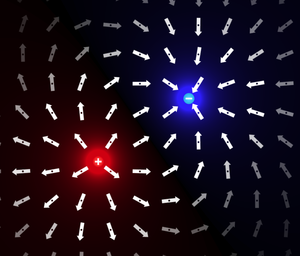
| − | To see the [[Electrostatic Field]] | + | To see the [[Electrostatic Field|electrostatic field]] created by a '''charge''' click on the picture below to play a PHET simulation. |
{| class="wikitable" | {| class="wikitable" | ||
|[[File:PhetCharges.png|centre|300px|link=https://phet.colorado.edu/sims/html/charges-and-fields/latest/charges-and-fields_en.html]] | |[[File:PhetCharges.png|centre|300px|link=https://phet.colorado.edu/sims/html/charges-and-fields/latest/charges-and-fields_en.html]] | ||
|} | |} | ||
| + | |||
| + | ==Key Stage 4== | ||
| + | ===Meaning=== | ||
| + | '''Charge''' is a [[property]] of [[matter]] that can cause an [[Electrostatic Force|electrostatic force]] between two [[object]]s. | ||
| + | |||
| + | ===About Charge=== | ||
| + | : The [[SI Unit]] of '''charge''' is the [[Coulomb]] (C). | ||
| + | : '''Charge''' is a [[scalar]] quantity as it has [[magnitude]] but does not have a direction. | ||
| + | : There are two types of '''charge'''; [[Positive Charge|positive]] and [[Negative Charge|negative]]. | ||
| + | : Like '''charges''' [[repel]] each other and opposite '''charges''' [[attract]] each other. | ||
| + | : '''Charges''' create an [[Electrostatic Field|electrostatic field]] which affects other '''charged''' [[object]]s. | ||
| + | : '''Charge''' is a conserved quantity which means; "'''Charge''' cannot be created or destroyed, it can only be transferred from one place to another." | ||
| + | : A flow of '''charge''' is an [[Electrical Current|electrical current]]. | ||
| + | |||
| + | ===Equation=== | ||
| + | ====Equation linking Charge, Current and Time==== | ||
| + | ''NB: You should remember this equation with charge as the subject of the formula.'' | ||
| + | |||
| + | '''Charge''' = (Current) x (time) | ||
| + | |||
| + | <math>Q=It</math> | ||
| + | |||
| + | Where | ||
| + | |||
| + | <math>Q</math> = The amount of [[Electrical Charge|charge]] flowing past a point. | ||
| + | |||
| + | <math>I</math> = The '''electrical current''' | ||
| + | |||
| + | <math>t</math> = The [[time]] taken for the [[Electrical Charge|charge]] to flow. | ||
| + | |||
| + | ====Equation linking Charge, Potential Difference and Energy Transferred==== | ||
| + | ''NB: You should remember this equation with energy transferred as the subject of the formula.'' | ||
| + | |||
| + | '''Charge''' = (Energy Transferred)/(Potential Difference) | ||
| + | |||
| + | <math>Q=\frac{E}{V}</math> | ||
| + | |||
| + | Where | ||
| + | |||
| + | <math>Q</math> = The amount of [[Electrical Charge|charge]] that moves between two points. | ||
| + | |||
| + | <math>E</math> = The [[Energy Transfer]]red by the '''charge'''. | ||
| + | |||
| + | <math>V</math> = The [[Potential Difference|potential difference]] between two points. | ||
| + | |||
| + | ===Example Calculations=== | ||
| + | ====Finding Current from Charge and Time==== | ||
| + | {| class="wikitable" | ||
| + | | style="height:20px; width:300px; text-align:center;" |A charge of 15 Coulombs passes through a point in a circuit ever 0.52 seconds. Calculate the current flowing past this point correct to two [[Significant Figures|significant figures]]. | ||
| + | | style="height:20px; width:300px; text-align:center;" |A capacitor stores a charge of 10C. It discharges in 12ms. Calculate the average current flowing out of the capacitor correct to two [[Significant Figures|significant figures]]. | ||
| + | |- | ||
| + | | style="height:20px; width:300px; text-align:left;" |'''1. State the known quantities in correct [[unit]]s.''' | ||
| + | |||
| + | Q = 15C | ||
| + | |||
| + | t = 0.52s | ||
| + | | style="height:20px; width:300px; text-align:left;" |'''1. State the known quantities in correct [[unit]]s.''' | ||
| + | |||
| + | Q = 10C | ||
| + | |||
| + | t = 12ms = 12x10<sup>-3</sup>s | ||
| + | |- | ||
| + | | style="height:20px; width: 300px; text-align:left;" |'''2. [[Substitute (Maths)|Substitute]] the numbers and [[Evaluate (Maths)|evaluate]].''' | ||
| + | |||
| + | <math>Q=It</math> | ||
| + | |||
| + | <math>15=I \times 0.52</math> | ||
| + | | style="height:20px; width: 300px; text-align:left;" |'''2. [[Substitute (Maths)|Substitute]] the numbers and [[Evaluate (Maths)|evaluate]].''' | ||
| + | |||
| + | <math>Q=It</math> | ||
| + | |||
| + | <math>10=I \times 12 \times 10^{-3}</math> | ||
| + | |- | ||
| + | | style="height:20px; width: 300px; text-align:left;" |'''3. [[Rearrange (Maths)|Rearrange]] the equation and [[Solve (Maths)|solve]].''' | ||
| + | |||
| + | <math>I=\frac{15}{0.52}</math> | ||
| + | |||
| + | <math>I=28.846153A</math> | ||
| + | |||
| + | <math>I\approx29A</math> | ||
| + | | style="height:20px; width: 300px; text-align:left;" |'''3. [[Rearrange (Maths)|Rearrange]] the equation and [[Solve (Maths)|solve]].''' | ||
| + | |||
| + | <math>I=\frac{10}{12 \times 10^{-3}}</math> | ||
| + | |||
| + | <math>I=833.3A</math> | ||
| + | |||
| + | <math>I\approx830A</math> | ||
| + | |} | ||
| + | |||
| + | ====Finding Charge from Current and Time==== | ||
| + | {| class="wikitable" | ||
| + | | style="height:20px; width: 300px; text-align:center;" |A battery supplies 4.7Amps to a bulb over a period of 14 seconds. Calculate the charge leaving the battery in this time correct to two [[Significant Figures|significant figures]]. | ||
| + | | style="height:20px; width: 300px; text-align:center;" |A hairdryer uses a current of 7.2A for 5 minutes to dry a person’s hair. Calculate the charge flowing through the hairdryer in this time correct to two [[Significant Figures|significant figures]]. | ||
| + | |- | ||
| + | | style="height:20px; width: 300px; text-align:left;" |'''1. State the known quantities in correct [[unit]]s.''' | ||
| + | |||
| + | I = 4.7A | ||
| + | |||
| + | t = 14s | ||
| + | | style="height:20px; width: 300px; text-align:left;" |'''1. State the known quantities in correct [[unit]]s.''' | ||
| + | |||
| + | I = 7.2A | ||
| + | |||
| + | t = 5min = 300s | ||
| + | |- | ||
| + | | style="height:20px; width:200px; text-align:left;" |'''2. [[Substitute (Maths)|Substitute]] the numbers into the [[equation]] and [[Solve (Maths)|solve]].''' | ||
| + | |||
| + | <math>Q=It</math> | ||
| + | |||
| + | <math>Q=4.7 \times 14</math> | ||
| + | |||
| + | <math>Q = 65.8C</math> | ||
| + | |||
| + | <math>Q \approx 66C</math> | ||
| + | | style="height:20px; width:200px; text-align:left;" |'''2. [[Substitute (Maths)|Substitute]] the numbers into the [[equation]] and [[Solve (Maths)|solve]].''' | ||
| + | |||
| + | <math>Q=It</math> | ||
| + | |||
| + | <math>Q=7.2 \times 300</math> | ||
| + | |||
| + | <math>Q = 2160C</math> | ||
| + | |||
| + | <math>Q \approx 2200C</math> | ||
| + | |} | ||
| + | |||
| + | ====Finding Time from Current and Charge==== | ||
| + | {| class="wikitable" | ||
| + | | style="height:20px; width: 300px; text-align:center;" |A battery charger uses a current of 150mA to deliver a charge of 245 Coloumbs to a battery. Calculate the time taken to charge this battery correct to two [[Significant Figures|significant figures]]. | ||
| + | | style="height:20px; width: 300px; text-align:center;" |A cloud in a thunderstorm loses 15C in one lightening strike. At a current of 31,000kA. Calculate how long this lightning strike lasts correct to two [[Significant Figures|significant figures]]. | ||
| + | |- | ||
| + | | style="height:20px; width: 300px; text-align:left;" |'''1. State the known quantities in correct [[unit]]s.''' | ||
| + | |||
| + | I = 150mA = 150x10<sup>-3</sup>A | ||
| + | |||
| + | Q = 245C | ||
| + | | style="height:20px; width: 300px; text-align:left;" |'''1. State the known quantities in correct [[unit]]s.''' | ||
| + | |||
| + | I = 31,000kA = 3.1x10<sup>7</sup>A | ||
| + | |||
| + | Q = 15C | ||
| + | |- | ||
| + | | style="height:20px; width: 300px; text-align:left;" |'''2. [[Substitute (Maths)|Substitute]] the numbers and [[Evaluate (Maths)|evaluate]].''' | ||
| + | |||
| + | <math>Q=It</math> | ||
| + | |||
| + | <math>245 = 150 \times 10^{-3} \times t</math> | ||
| + | |||
| + | | style="height:20px; width: 300px; text-align:left;" |'''2. [[Substitute (Maths)|Substitute]] the numbers and [[Evaluate (Maths)|evaluate]].''' | ||
| + | |||
| + | <math>Q=It</math> | ||
| + | |||
| + | <math>15= 3.1 \times 10^7 \times t</math> | ||
| + | |- | ||
| + | | style="height:20px; width: 300px; text-align:left;" |'''3. [[Rearrange (Maths)|Rearrange]] the equation and [[Solve (Maths)|solve]].''' | ||
| + | |||
| + | <math>t=\frac{245}{150 \times 10^{-3}}</math> | ||
| + | |||
| + | <math>t=1633.3s</math> | ||
| + | |||
| + | <math>t\approx1633.3s</math> | ||
| + | | style="height:20px; width: 300px; text-align:left;" |'''3. [[Rearrange (Maths)|Rearrange]] the equation and [[Solve (Maths)|solve]].''' | ||
| + | |||
| + | <math>t=\frac{15}{3.1 \times 10^7}</math> | ||
| + | |||
| + | <math>t = 4.8387 \times 10^{-7}s</math> | ||
| + | |||
| + | <math>t\approx4.8 \times 10^{-7}s</math> | ||
| + | |} | ||
| + | |||
| + | ====Finding Charge from Potential Difference and Energy Transferred==== | ||
| + | {| class="wikitable" | ||
| + | | style="height:20px; width:300px; text-align:center;" |The [[Potential Difference|potential difference]] of 12V is placed across a [[Electrical Resistor|resistor]] increasing its [[Thermal Energy Store|thermal energy store]] by 3.7J as a result. Calculate the '''charge''' that has flowed through the [[Electrical Resistor|resistor]] in this time correct to two [[Significant Figures|significant figures]]. | ||
| + | | style="height:20px; width:300px; text-align:center;" |A [[circuit]] transfers 2.8kJ of [[energy]] [[electrically]] to a [[motor]]. The [[Potential Difference|potential difference]] across the [[motor]] is 1.5V. Calculate the'''charge''' that has flowed through the [[motor]] in this time correct to two [[Significant Figures|significant figures]]. | ||
| + | |- | ||
| + | | style="height:20px; width:300px; text-align:left;" |'''1. State the known quantities in correct [[unit]]s.''' | ||
| + | |||
| + | V = 12V | ||
| + | |||
| + | E = 3.7J | ||
| + | | style="height:20px; width:300px; text-align:left;" |'''1. State the known quantities in correct [[unit]]s.''' | ||
| + | |||
| + | V = 1.5V | ||
| + | |||
| + | E = 2.8kJ = 2.8x10<sup>3</sup>J | ||
| + | |- | ||
| + | | style="height:20px; width:300px; text-align:left;" |'''2. [[Substitute (Maths)|Substitute]] the numbers into the [[equation]] and [[Solve (Maths)|solve]].''' | ||
| + | |||
| + | <math>Q=\frac{E}{V}</math> | ||
| + | |||
| + | <math>Q=\frac{3.7}{12}</math> | ||
| + | |||
| + | <math>Q=0.3083C</math> | ||
| + | |||
| + | <math>Q\approx0.31C</math> | ||
| + | | style="height:20px; width:300px; text-align:left;" |'''2. [[Substitute (Maths)|Substitute]] the numbers into the [[equation]] and [[Solve (Maths)|solve]].''' | ||
| + | |||
| + | <math>Q=\frac{E}{V}</math> | ||
| + | |||
| + | <math>Q=\frac{2.8 \times 10^3}{1.5}</math> | ||
| + | |||
| + | <math>Q=1866.7C</math> | ||
| + | |||
| + | <math>Q\approx1900C</math> | ||
| + | |} | ||
| + | |||
| + | ====Finding Potential Difference from Charge and Energy Transferred==== | ||
| + | {| class="wikitable" | ||
| + | | style="height:20px; width: 300px; text-align:center;" |A '''charge''' of 84C transfers an [[energy]] of 20kJ. Calculate the [[Potential Difference|potential difference]] correct to two [[Significant Figures|significant figures]]. | ||
| + | | style="height:20px; width: 300px; text-align:center;" |170J of [[energy]] is transferred by a '''charge''' of 92mC. Calculate the [[Potential Difference|potential difference]] correct to two [[Significant Figures|significant figures]]. | ||
| + | |- | ||
| + | | style="height:20px; width: 300px; text-align:left;" |'''1. State the known quantities in correct [[unit]]s.''' | ||
| + | Q = 84C | ||
| + | |||
| + | E = 20kJ = 20x10<sup>3</sup>J | ||
| + | | style="height:20px; width: 300px; text-align:left;" |'''1. State the known quantities in correct [[unit]]s.''' | ||
| + | |||
| + | Q = 92mC = 92x10<sup>-3</sup>C | ||
| + | |||
| + | E = 170J | ||
| + | |- | ||
| + | | style="height:20px; width: 300px; text-align:left;" |'''2. [[Substitute (Maths)|Substitute]] the numbers and [[Evaluate (Maths)|evaluate]].''' | ||
| + | |||
| + | <math>Q=\frac{E}{V}</math> | ||
| + | |||
| + | <math>84=\frac{20 \times 10^3}{V}</math> | ||
| + | |||
| + | | style="height:20px; width: 300px; text-align:left;" |'''2. [[Substitute (Maths)|Substitute]] the numbers and [[Evaluate (Maths)|evaluate]].''' | ||
| + | |||
| + | <math>Q=\frac{E}{V}</math> | ||
| + | |||
| + | <math>92 \times 10^{-3}=\frac{170}{V}</math> | ||
| + | |||
| + | |- | ||
| + | | style="height:20px; width: 300px; text-align:left;" |'''3. [[Rearrange (Maths)|Rearrange]] the equation and [[Solve (Maths)|solve]].''' | ||
| + | |||
| + | <math>V=\frac{20 \times 10^3}{84}</math> | ||
| + | |||
| + | <math>V=238.0952V</math> | ||
| + | |||
| + | <math>V\approx 240V</math> | ||
| + | |||
| + | | style="height:20px; width: 300px; text-align:left;" |'''3. [[Rearrange (Maths)|Rearrange]] the equation and [[Solve (Maths)|solve]].''' | ||
| + | |||
| + | <math>V=\frac{170}{92 \times 10^{-3}}</math> | ||
| + | |||
| + | <math>V=1847.826V</math> | ||
| + | |||
| + | <math>V\approx 1800V</math> | ||
| + | |} | ||
| + | |||
| + | ====Finding Energy Transferred from Charge and Potential Difference==== | ||
| + | {| class="wikitable" | ||
| + | | style="height:20px; width: 300px; text-align:center;" |A bolt of lightning with a [[Potential Difference|potential difference]] 31,000kV transfers a '''charge''' of 15C. Calculate the [[Energy Transfer|energy transferred]] by this bolt of [[lightning]] correct to two [[Significant Figures|significant figures]]. | ||
| + | | style="height:20px; width: 300px; text-align:center;" |A 9V [[Electrical Battery|battery]] is able to mobilise a '''charge''' of 4.3kC during its operation. Calculate the total amount of [[energy]] stored in this [[Electrical Battery|battery]] correct to two [[Significant Figures|significant figures]]. | ||
| + | |- | ||
| + | | style="height:20px; width: 300px; text-align:left;" |'''1. State the known quantities in correct [[unit]]s.''' | ||
| + | |||
| + | V = 31,000kV = 3.1x10<sup>7</sup>V | ||
| + | |||
| + | Q = 15C | ||
| + | | style="height:20px; width: 300px; text-align:left;" |'''1. State the known quantities in correct [[unit]]s.''' | ||
| + | |||
| + | V = 9V | ||
| + | |||
| + | Q = 4.3kC = 4.3x10<sup>3</sup> | ||
| + | |- | ||
| + | | style="height:20px; width: 300px; text-align:left;" |'''2. [[Substitute (Maths)|Substitute]] the numbers and [[Evaluate (Maths)|evaluate]].''' | ||
| + | |||
| + | <math>Q=\frac{E}{V}</math> | ||
| + | |||
| + | <math>15=\frac{E}{3.1 \times 10^7}</math> | ||
| + | |||
| + | | style="height:20px; width: 300px; text-align:left;" |'''2. [[Substitute (Maths)|Substitute]] the numbers and [[Evaluate (Maths)|evaluate]].''' | ||
| + | |||
| + | <math>Q=\frac{E}{V}</math> | ||
| + | |||
| + | <math>4.3 \times 10^3 =\frac{E}{9}</math> | ||
| + | |- | ||
| + | | style="height:20px; width: 300px; text-align:left;" |'''3. [[Rearrange (Maths)|Rearrange]] the equation and [[Solve (Maths)|solve]].''' | ||
| + | |||
| + | <math>E = 15 \times 3.1 \times 10^7</math> | ||
| + | |||
| + | <math>E = 4.65\times10^8 J</math> | ||
| + | |||
| + | <math>E\approx4.7\times10^8 J</math> | ||
| + | |||
| + | | style="height:20px; width: 300px; text-align:left;" |'''3. [[Rearrange (Maths)|Rearrange]] the equation and [[Solve (Maths)|solve]].''' | ||
| + | |||
| + | <math>E = 4.3 \times 10^3 \times 9</math> | ||
| + | |||
| + | <math>E = 38700J</math> | ||
| + | |||
| + | <math>E \approx 39000 \times 10^4J</math> | ||
| + | |} | ||
| + | |||
| + | ===References=== | ||
| + | ====AQA==== | ||
| + | |||
| + | :[https://www.amazon.co.uk/gp/product/0008158770/ref=as_li_tl?ie=UTF8&camp=1634&creative=6738&creativeASIN=0008158770&linkCode=as2&tag=nrjc-21&linkId=ec31595e720e1529e49876c3866fff6e ''Charge (electrical), pages 46-52, 71, 74-5, GCSE Physics; Student Book, Collins, AQA ''] | ||
| + | :[https://www.amazon.co.uk/gp/product/178294558X/ref=as_li_tl?ie=UTF8&camp=1634&creative=6738&creativeASIN=178294558X&linkCode=as2&tag=nrjc-21&linkId=f0dfb66dafcb0c6e9449e7b1a4ae1ac43 ''Charge; electric, page 24, GCSE Physics; The Revision Guide, CGP, AQA ''] | ||
| + | :[https://www.amazon.co.uk/gp/product/1782945598/ref=as_li_tl?ie=UTF8&camp=1634&creative=6738&creativeASIN=1782945598&linkCode=as2&tag=nrjc-21&linkId=ad276ad49df77ab4b40ab4fd0fe09760 ''Charge; electric, pages 180, 189, 190, GCSE Combined Science; The Revision Guide, CGP, AQA ''] | ||
| + | :[https://www.amazon.co.uk/gp/product/1782946403/ref=as_li_tl?ie=UTF8&camp=1634&creative=6738&creativeASIN=1782946403&linkCode=as2&tag=nrjc-21&linkId=32a0abb60dff015b15b50e9b1d7b4644 ''Charge; electric, pages 61, 88-90, GCSE Combined Science Trilogy; Physics, CGP, AQA ''] | ||
| + | :[https://www.amazon.co.uk/gp/product/1782945970/ref=as_li_tl?ie=UTF8&camp=1634&creative=6738&creativeASIN=1782945970&linkCode=as2&tag=nrjc-21&linkId=a120d24dcc7cc7a58192069a3aafc1d2 ''Charge; electric, pages 63, 91-93, GCSE Physics; The Complete 9-1 Course for AQA, CGP, AQA ''] | ||
| + | :[https://www.amazon.co.uk/gp/product/178294558X/ref=as_li_tl?ie=UTF8&camp=1634&creative=6738&creativeASIN=178294558X&linkCode=as2&tag=nrjc-21&linkId=f0dfb66dafcb0c6e9449e7b1a4ae1ac111 ''Electric charge, page 24, GCSE Physics; The Revision Guide, CGP, AQA ''] | ||
| + | :[https://www.amazon.co.uk/gp/product/1782945598/ref=as_li_tl?ie=UTF8&camp=1634&creative=6738&creativeASIN=1782945598&linkCode=as2&tag=nrjc-21&linkId=ad276ad49df77ab4b40ab4fd0fe09875 ''Electric charge, pages 180, 189, 190, GCSE Combined Science; The Revision Guide, CGP, AQA ''] | ||
| + | :[https://www.amazon.co.uk/gp/product/1782946403/ref=as_li_tl?ie=UTF8&camp=1634&creative=6738&creativeASIN=1782946403&linkCode=as2&tag=nrjc-21&linkId=32a0abb60dff015b15b50e9b1d7b4644 ''Electric charge, pages 61, 88-90, GCSE Combined Science Trilogy; Physics, CGP, AQA ''] | ||
| + | :[https://www.amazon.co.uk/gp/product/1782945970/ref=as_li_tl?ie=UTF8&camp=1634&creative=6738&creativeASIN=1782945970&linkCode=as2&tag=nrjc-21&linkId=a120d24dcc7cc7a58192069a3aafc1d2 ''Electric charge, pages 63, 91-93, GCSE Physics; The Complete 9-1 Course for AQA, CGP, AQA ''] | ||
| + | :[https://www.amazon.co.uk/gp/product/1782946403/ref=as_li_tl?ie=UTF8&camp=1634&creative=6738&creativeASIN=1782946403&linkCode=as2&tag=nrjc-21&linkId=32a0abb60dff015b15b50e9b1d7b4644 ''Electric charge; ions, page 112, GCSE Combined Science Trilogy; Physics, CGP, AQA ''] | ||
| + | :[https://www.amazon.co.uk/gp/product/1782945970/ref=as_li_tl?ie=UTF8&camp=1634&creative=6738&creativeASIN=1782945970&linkCode=as2&tag=nrjc-21&linkId=a120d24dcc7cc7a58192069a3aafc1d2 ''Electric charge; ions, page 124, GCSE Physics; The Complete 9-1 Course for AQA, CGP, AQA ''] | ||
| + | :[https://www.amazon.co.uk/gp/product/1782946403/ref=as_li_tl?ie=UTF8&camp=1634&creative=6738&creativeASIN=1782946403&linkCode=as2&tag=nrjc-21&linkId=32a0abb60dff015b15b50e9b1d7b4644 ''Electric charge; of an atom, page 111, GCSE Combined Science Trilogy; Physics, CGP, AQA ''] | ||
| + | :[https://www.amazon.co.uk/gp/product/1782945970/ref=as_li_tl?ie=UTF8&camp=1634&creative=6738&creativeASIN=1782945970&linkCode=as2&tag=nrjc-21&linkId=a120d24dcc7cc7a58192069a3aafc1d2 ''Electric charge; of an atom, page 123, GCSE Physics; The Complete 9-1 Course for AQA, CGP, AQA ''] | ||
| + | :[https://www.amazon.co.uk/gp/product/1782946403/ref=as_li_tl?ie=UTF8&camp=1634&creative=6738&creativeASIN=1782946403&linkCode=as2&tag=nrjc-21&linkId=32a0abb60dff015b15b50e9b1d7b4644 ''Electric charge; relative charge, page 111, GCSE Combined Science Trilogy; Physics, CGP, AQA ''] | ||
| + | :[https://www.amazon.co.uk/gp/product/1782945970/ref=as_li_tl?ie=UTF8&camp=1634&creative=6738&creativeASIN=1782945970&linkCode=as2&tag=nrjc-21&linkId=a120d24dcc7cc7a58192069a3aafc1d2 ''Electric charge; relative charge, page 123, GCSE Physics; The Complete 9-1 Course for AQA, CGP, AQA ''] | ||
| + | :[https://www.amazon.co.uk/gp/product/1782945970/ref=as_li_tl?ie=UTF8&camp=1634&creative=6738&creativeASIN=1782945970&linkCode=as2&tag=nrjc-21&linkId=a120d24dcc7cc7a58192069a3aafc1d2 ''Electric charge; static, pages 99, 103, GCSE Physics; The Complete 9-1 Course for AQA, CGP, AQA ''] | ||
| + | |||
| + | ====Edexcel==== | ||
| + | |||
| + | :[https://www.amazon.co.uk/gp/product/1782948163/ref=as_li_tl?ie=UTF8&camp=1634&creative=6738&creativeASIN=1782948163&linkCode=as2&tag=nrjc-21&linkId=0fdbfd5dd397d6e24a9dfb250f08587f ''Charge (electric), page 221, GCSE Physics, CGP, Edexcel ''] | ||
| + | :[https://www.amazon.co.uk/gp/product/1292120223/ref=as_li_tl?ie=UTF8&camp=1634&creative=6738&creativeASIN=1292120223&linkCode=as2&tag=nrjc-21&linkId=068ecf40278c32406a7f1c6e66751417 ''Charge, electrical, pages 144, 160-161, GCSE Physics, Pearson Edexcel ''] | ||
| + | :[https://www.amazon.co.uk/gp/product/1292120223/ref=as_li_tl?ie=UTF8&camp=1634&creative=6738&creativeASIN=1292120223&linkCode=as2&tag=nrjc-21&linkId=068ecf40278c32406a7f1c6e66751417 ''Charge, electrical; energy, page 145, GCSE Physics, Pearson Edexcel ''] | ||
| + | :[https://www.amazon.co.uk/gp/product/1292120223/ref=as_li_tl?ie=UTF8&camp=1634&creative=6738&creativeASIN=1292120223&linkCode=as2&tag=nrjc-21&linkId=068ecf40278c32406a7f1c6e66751417 ''Charge, electrical; point charges, page 164, GCSE Physics, Pearson Edexcel ''] | ||
| + | |||
| + | ====OCR==== | ||
| + | :[https://www.amazon.co.uk/gp/product/0198359837/ref=as_li_tl?ie=UTF8&camp=1634&creative=6738&creativeASIN=0198359837&linkCode=as2&tag=nrjc-21&linkId=3c4229e8b023b2b60768e7ea2307cc6f ''Electric charge, pages 94-97, 101, Gateway GCSE Physics, Oxford, OCR ''] | ||
| + | |||
| + | ==Key Stage 5== | ||
| + | ===Meaning=== | ||
| + | '''Electrical charge''' is a [[Conservation of Charge|conserved]] quantity and a [[property]] of [[Subatomic Particle|particle]]s which allow them to interact via the [[Electromagnetic Interaction|electromagnetic interaction]]. | ||
| + | |||
| + | ===About Electrical Charge=== | ||
| + | : The [[SI Unit]] of '''charge''' is the [[Coulomb]] (C). | ||
| + | : '''Charge''' is a [[scalar]] quantity as it has [[magnitude]] but does not have a direction. | ||
| + | : '''Charges''' create an [[Electrostatic Field|electrostatic field]] which affects other '''charged''' [[object]]s. | ||
| + | : '''Charge''' is a conserved quantity which means; "'''Charge''' cannot be created or destroyed, it can only be transferred from one place to another." | ||
| + | : A flow of '''charge''' is an [[Electrical Current|electrical current]]. | ||
| + | |||
| + | ===About Electrical Charge at the Particle Level=== | ||
| + | : '''Charged''' [[Subatomic Particle|particles]] may exchange virtual [[photon]]s causing a change in their [[momentum]]. This results in the [[force]] of [[attract]]ion or [[repel|repulsion]] between '''charged''' [[Subatomic Particle|particles]]. | ||
| + | : As a [[Conservation of Charge|conserved quantity]] '''charge''' cannot be created or destroyed, but it can be transferred from one [[Subatomic Particle|particle]] to another. This occurs in the [[Weak Nuclear Interaction|weak interaction]] via the [[W-boson]]. | ||
| + | : The [[Electrical Charge|electrical charge]] passed between [[Subatomic Particle|subatomic particles]] during the [[Weak Nuclear Interaction|weak interaction]] has a [[magnitude]] of 1.60x10<sup>-19</sup> [[Coulomb]]s (the [[Elementary Charge|elementary charge]]). | ||
| + | : The [[Electrical Charge|electrical charge]] of the [[proton]] is +1.60x10<sup>-19</sup> [[Coulomb]]s and the [[Electrical Charge|electrical charge]] of the [[electron]] is -1.60x10<sup>-19</sup> [[Coulomb]]s. | ||
Latest revision as of 01:46, 5 December 2019
Contents
- 1 Key Stage 3
- 2 Key Stage 4
- 2.1 Meaning
- 2.2 About Charge
- 2.3 Equation
- 2.4 Example Calculations
- 2.4.1 Finding Current from Charge and Time
- 2.4.2 Finding Charge from Current and Time
- 2.4.3 Finding Time from Current and Charge
- 2.4.4 Finding Charge from Potential Difference and Energy Transferred
- 2.4.5 Finding Potential Difference from Charge and Energy Transferred
- 2.4.6 Finding Energy Transferred from Charge and Potential Difference
- 2.5 References
- 3 Key Stage 5
Key Stage 3
Meaning
Charge is a property of matter that can cause an electrostatic force between two objects.
About Charge
- There are two types of charge; positive and negative.
- Like charges repel each other and opposite charges attract each other.
- Charges create an electrostatic field which affects other charged objects.
To see the electrostatic field created by a charge click on the picture below to play a PHET simulation.
 |
Key Stage 4
Meaning
Charge is a property of matter that can cause an electrostatic force between two objects.
About Charge
- The SI Unit of charge is the Coulomb (C).
- Charge is a scalar quantity as it has magnitude but does not have a direction.
- There are two types of charge; positive and negative.
- Like charges repel each other and opposite charges attract each other.
- Charges create an electrostatic field which affects other charged objects.
- Charge is a conserved quantity which means; "Charge cannot be created or destroyed, it can only be transferred from one place to another."
- A flow of charge is an electrical current.
Equation
Equation linking Charge, Current and Time
NB: You should remember this equation with charge as the subject of the formula.
Charge = (Current) x (time)
\(Q=It\)
Where
\(Q\) = The amount of charge flowing past a point.
\(I\) = The electrical current
\(t\) = The time taken for the charge to flow.
Equation linking Charge, Potential Difference and Energy Transferred
NB: You should remember this equation with energy transferred as the subject of the formula.
Charge = (Energy Transferred)/(Potential Difference)
\(Q=\frac{E}{V}\)
Where
\(Q\) = The amount of charge that moves between two points.
\(E\) = The Energy Transferred by the charge.
\(V\) = The potential difference between two points.
Example Calculations
Finding Current from Charge and Time
| A charge of 15 Coulombs passes through a point in a circuit ever 0.52 seconds. Calculate the current flowing past this point correct to two significant figures. | A capacitor stores a charge of 10C. It discharges in 12ms. Calculate the average current flowing out of the capacitor correct to two significant figures. |
| 1. State the known quantities in correct units.
Q = 15C t = 0.52s |
1. State the known quantities in correct units.
Q = 10C t = 12ms = 12x10-3s |
| 2. Substitute the numbers and evaluate.
\(Q=It\) \(15=I \times 0.52\) |
2. Substitute the numbers and evaluate.
\(Q=It\) \(10=I \times 12 \times 10^{-3}\) |
| 3. Rearrange the equation and solve.
\(I=\frac{15}{0.52}\) \(I=28.846153A\) \(I\approx29A\) |
3. Rearrange the equation and solve.
\(I=\frac{10}{12 \times 10^{-3}}\) \(I=833.3A\) \(I\approx830A\) |
Finding Charge from Current and Time
| A battery supplies 4.7Amps to a bulb over a period of 14 seconds. Calculate the charge leaving the battery in this time correct to two significant figures. | A hairdryer uses a current of 7.2A for 5 minutes to dry a person’s hair. Calculate the charge flowing through the hairdryer in this time correct to two significant figures. |
| 1. State the known quantities in correct units.
I = 4.7A t = 14s |
1. State the known quantities in correct units.
I = 7.2A t = 5min = 300s |
| 2. Substitute the numbers into the equation and solve.
\(Q=It\) \(Q=4.7 \times 14\) \(Q = 65.8C\) \(Q \approx 66C\) |
2. Substitute the numbers into the equation and solve.
\(Q=It\) \(Q=7.2 \times 300\) \(Q = 2160C\) \(Q \approx 2200C\) |
Finding Time from Current and Charge
| A battery charger uses a current of 150mA to deliver a charge of 245 Coloumbs to a battery. Calculate the time taken to charge this battery correct to two significant figures. | A cloud in a thunderstorm loses 15C in one lightening strike. At a current of 31,000kA. Calculate how long this lightning strike lasts correct to two significant figures. |
| 1. State the known quantities in correct units.
I = 150mA = 150x10-3A Q = 245C |
1. State the known quantities in correct units.
I = 31,000kA = 3.1x10⁷A Q = 15C |
| 2. Substitute the numbers and evaluate.
\(Q=It\) \(245 = 150 \times 10^{-3} \times t\) |
2. Substitute the numbers and evaluate.
\(Q=It\) \(15= 3.1 \times 10^7 \times t\) |
| 3. Rearrange the equation and solve.
\(t=\frac{245}{150 \times 10^{-3}}\) \(t=1633.3s\) \(t\approx1633.3s\) |
3. Rearrange the equation and solve.
\(t=\frac{15}{3.1 \times 10^7}\) \(t = 4.8387 \times 10^{-7}s\) \(t\approx4.8 \times 10^{-7}s\) |
Finding Charge from Potential Difference and Energy Transferred
| The potential difference of 12V is placed across a resistor increasing its thermal energy store by 3.7J as a result. Calculate the charge that has flowed through the resistor in this time correct to two significant figures. | A circuit transfers 2.8kJ of energy electrically to a motor. The potential difference across the motor is 1.5V. Calculate thecharge that has flowed through the motor in this time correct to two significant figures. |
| 1. State the known quantities in correct units.
V = 12V E = 3.7J |
1. State the known quantities in correct units.
V = 1.5V E = 2.8kJ = 2.8x10³J |
| 2. Substitute the numbers into the equation and solve.
\(Q=\frac{E}{V}\) \(Q=\frac{3.7}{12}\) \(Q=0.3083C\) \(Q\approx0.31C\) |
2. Substitute the numbers into the equation and solve.
\(Q=\frac{E}{V}\) \(Q=\frac{2.8 \times 10^3}{1.5}\) \(Q=1866.7C\) \(Q\approx1900C\) |
Finding Potential Difference from Charge and Energy Transferred
| A charge of 84C transfers an energy of 20kJ. Calculate the potential difference correct to two significant figures. | 170J of energy is transferred by a charge of 92mC. Calculate the potential difference correct to two significant figures. |
| 1. State the known quantities in correct units.
Q = 84C E = 20kJ = 20x103J |
1. State the known quantities in correct units.
Q = 92mC = 92x10-3C E = 170J |
| 2. Substitute the numbers and evaluate.
\(Q=\frac{E}{V}\) \(84=\frac{20 \times 10^3}{V}\) |
2. Substitute the numbers and evaluate.
\(Q=\frac{E}{V}\) \(92 \times 10^{-3}=\frac{170}{V}\) |
| 3. Rearrange the equation and solve.
\(V=\frac{20 \times 10^3}{84}\) \(V=238.0952V\) \(V\approx 240V\) |
3. Rearrange the equation and solve.
\(V=\frac{170}{92 \times 10^{-3}}\) \(V=1847.826V\) \(V\approx 1800V\) |
Finding Energy Transferred from Charge and Potential Difference
| A bolt of lightning with a potential difference 31,000kV transfers a charge of 15C. Calculate the energy transferred by this bolt of lightning correct to two significant figures. | A 9V battery is able to mobilise a charge of 4.3kC during its operation. Calculate the total amount of energy stored in this battery correct to two significant figures. |
| 1. State the known quantities in correct units.
V = 31,000kV = 3.1x10⁷V Q = 15C |
1. State the known quantities in correct units.
V = 9V Q = 4.3kC = 4.3x10³ |
| 2. Substitute the numbers and evaluate.
\(Q=\frac{E}{V}\) \(15=\frac{E}{3.1 \times 10^7}\) |
2. Substitute the numbers and evaluate.
\(Q=\frac{E}{V}\) \(4.3 \times 10^3 =\frac{E}{9}\) |
| 3. Rearrange the equation and solve.
\(E = 15 \times 3.1 \times 10^7\) \(E = 4.65\times10^8 J\) \(E\approx4.7\times10^8 J\) |
3. Rearrange the equation and solve.
\(E = 4.3 \times 10^3 \times 9\) \(E = 38700J\) \(E \approx 39000 \times 10^4J\) |
References
AQA
- Charge (electrical), pages 46-52, 71, 74-5, GCSE Physics; Student Book, Collins, AQA
- Charge; electric, page 24, GCSE Physics; The Revision Guide, CGP, AQA
- Charge; electric, pages 180, 189, 190, GCSE Combined Science; The Revision Guide, CGP, AQA
- Charge; electric, pages 61, 88-90, GCSE Combined Science Trilogy; Physics, CGP, AQA
- Charge; electric, pages 63, 91-93, GCSE Physics; The Complete 9-1 Course for AQA, CGP, AQA
- Electric charge, page 24, GCSE Physics; The Revision Guide, CGP, AQA
- Electric charge, pages 180, 189, 190, GCSE Combined Science; The Revision Guide, CGP, AQA
- Electric charge, pages 61, 88-90, GCSE Combined Science Trilogy; Physics, CGP, AQA
- Electric charge, pages 63, 91-93, GCSE Physics; The Complete 9-1 Course for AQA, CGP, AQA
- Electric charge; ions, page 112, GCSE Combined Science Trilogy; Physics, CGP, AQA
- Electric charge; ions, page 124, GCSE Physics; The Complete 9-1 Course for AQA, CGP, AQA
- Electric charge; of an atom, page 111, GCSE Combined Science Trilogy; Physics, CGP, AQA
- Electric charge; of an atom, page 123, GCSE Physics; The Complete 9-1 Course for AQA, CGP, AQA
- Electric charge; relative charge, page 111, GCSE Combined Science Trilogy; Physics, CGP, AQA
- Electric charge; relative charge, page 123, GCSE Physics; The Complete 9-1 Course for AQA, CGP, AQA
- Electric charge; static, pages 99, 103, GCSE Physics; The Complete 9-1 Course for AQA, CGP, AQA
Edexcel
- Charge (electric), page 221, GCSE Physics, CGP, Edexcel
- Charge, electrical, pages 144, 160-161, GCSE Physics, Pearson Edexcel
- Charge, electrical; energy, page 145, GCSE Physics, Pearson Edexcel
- Charge, electrical; point charges, page 164, GCSE Physics, Pearson Edexcel
OCR
Key Stage 5
Meaning
Electrical charge is a conserved quantity and a property of particles which allow them to interact via the electromagnetic interaction.
About Electrical Charge
- The SI Unit of charge is the Coulomb (C).
- Charge is a scalar quantity as it has magnitude but does not have a direction.
- Charges create an electrostatic field which affects other charged objects.
- Charge is a conserved quantity which means; "Charge cannot be created or destroyed, it can only be transferred from one place to another."
- A flow of charge is an electrical current.
About Electrical Charge at the Particle Level
- Charged particles may exchange virtual photons causing a change in their momentum. This results in the force of attraction or repulsion between charged particles.
- As a conserved quantity charge cannot be created or destroyed, but it can be transferred from one particle to another. This occurs in the weak interaction via the W-boson.
- The electrical charge passed between subatomic particles during the weak interaction has a magnitude of 1.60x10⁻¹⁹ Coulombs (the elementary charge).
- The electrical charge of the proton is +1.60x10⁻¹⁹ Coulombs and the electrical charge of the electron is -1.60x10⁻¹⁹ Coulombs.